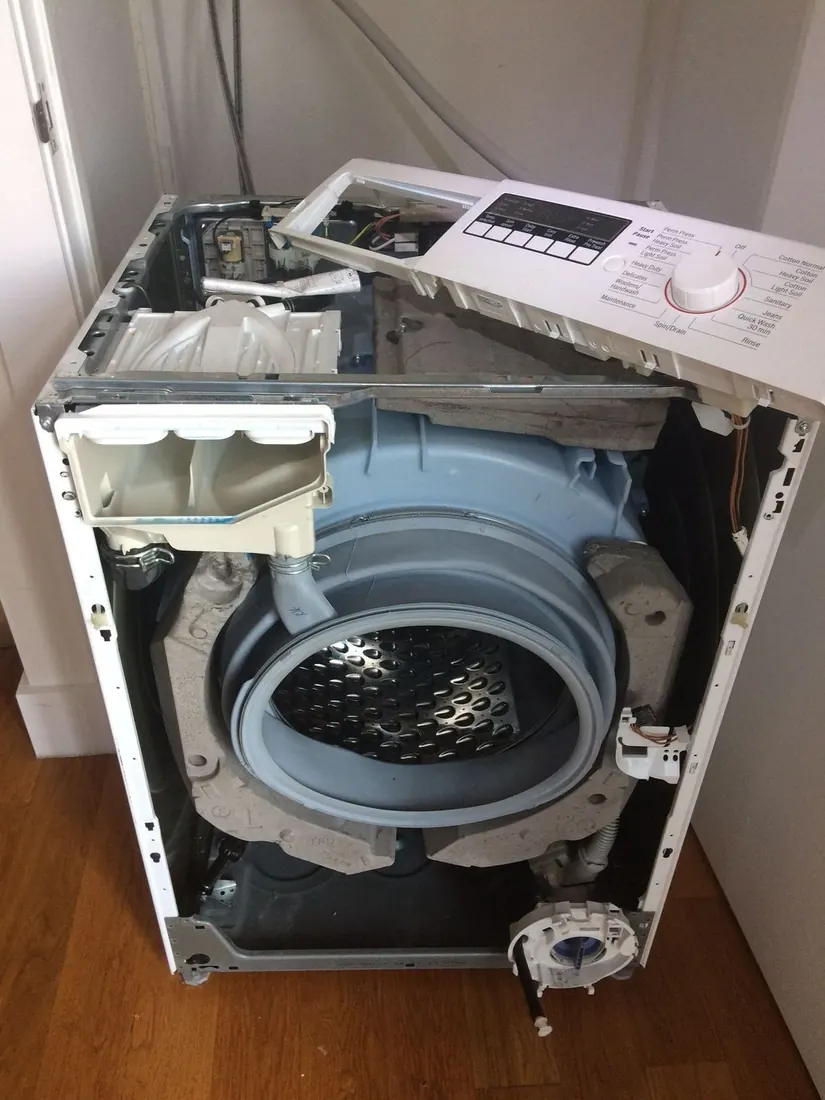
We investigate faults around Silver Lakes according to the cycle stage and the way the washer is installed. For example, cycle ends but clothing remains soaking wet is a different diagnostic path from standing water after the programme; one may involve a water or drive component, while the other requires checking how the appliance responds during its operating sequence. The fault patterns below explain the distinctions we look for before recommending work.
Cycle ends but clothing remains soaking wet
Wet laundry after a completed cycle can result from interrupted draining, low spin speed selection, imbalance protection or a failing drive component. A completed timer display does not prove that full-speed extraction happened.
We ask about the load size, selected programme and whether the machine attempted a final spin. This prevents a drainage or sensor issue from being mistaken for a faulty motor.
While arranging service: Check the programme setting and avoid repeated overloaded spin attempts.
Standing water after the programme
A tub that still contains water at the end of the cycle can point to a restricted drain path, a blocked pump housing, a collapsed outlet hose or an electrical fault in the pump circuit. We first distinguish a machine that never attempts to empty from one that pumps briefly but cannot clear the water.
The repair depends on whether flow is physically blocked or the pump is failing under load. Replacing a pump without checking the hose and filter may leave the same fault in place.
While arranging service: Keep the door closed if water is above its lower edge; do not force the latch.
Rust marks or water below the cabinet
Water near the cabinet base may indicate leaks from a pump, internal hose, tub seal or damaged casing, depending on the design. Corrosion can be a consequence of a long-term leak rather than the primary failure.
The underside and hose joints require careful inspection with the appliance safely isolated. Surface rust alone does not identify the failed part, and we examine whether the chassis remains safe to use.
While arranging service: Disconnect power if water is close to electrical components.
Cycle takes unusually long
Long wash times can follow water-temperature problems, repeated balancing attempts, slow filling or extra rinse routines triggered by foam. Some eco programmes are intentionally longer, so the selected mode is essential context.
We separate normal programme behaviour from a new time delay and observe the point at which progress slows. A specific diagnosis avoids replacing timers for unrelated fill or heating problems.
While arranging service: Compare the same programme under a similar load, without running an unsafe machine.