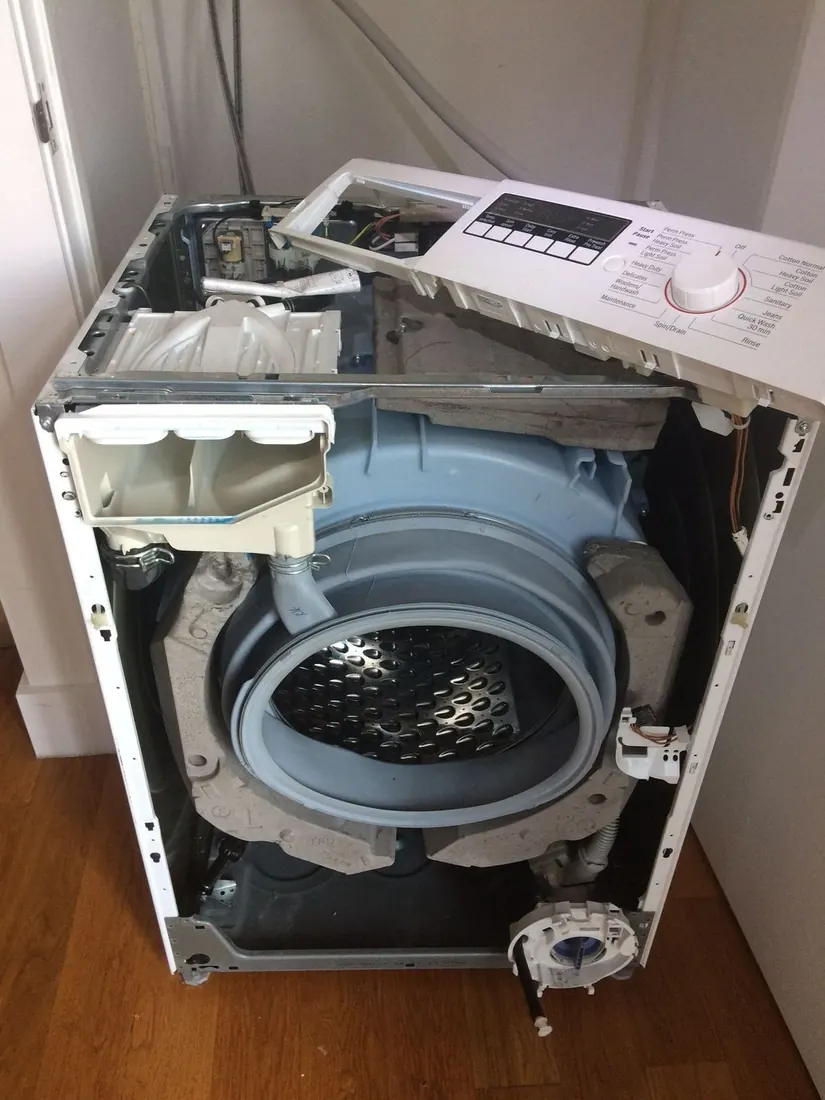
We investigate faults around Hennopspark according to the cycle stage and the way the washer is installed. For example, hot-water or heating faults is a different diagnostic path from washer-dryer does not dry properly; one may involve a water or drive component, while the other requires checking how the appliance responds during its operating sequence. The fault patterns below explain the distinctions we look for before recommending work.
Hot-water or heating faults
Cold washing despite a hot programme can reflect a failed heater, a thermistor problem or a control issue. An unusually long programme may signal that the machine cannot reach the expected temperature.
Measured temperature and electrical tests determine whether the machine is heating correctly. We do not recommend opening heater terminals or probing live circuits at home.
While arranging service: Mention whether the issue affects all hot programmes or only one.
Washer-dryer does not dry properly
A combined washer-dryer may wash normally yet fail to dry because of restricted airflow, temperature-sensing problems, load size or condensate management. Its drying system differs from a standard washer.
We confirm whether the appliance is a combined unit and review its drying cycle separately. A drying complaint should not be treated as a washing-motor fault without evidence.
While arranging service: Give the full model number and say whether the wash cycle still works.
Excessive vibration on tiled flooring
Loud movement during a high-speed spin is not always evidence of a failed drum bearing. Uneven feet, slippery flooring, poor load distribution, shipping bolts left in a recently installed machine and failed shock absorbers can all contribute.
A repeatable unloaded and loaded observation helps separate installation causes from mechanical wear. We also look for cabinet contact and evidence that the appliance has been walking from its position.
While arranging service: Stop the cycle if the unit is striking cabinetry or moving towards a hose.
Machine stops halfway through washing
An intermittent pause may be triggered by water-fill timeouts, heater faults, an unreliable door lock, motor overheating or a control error. Exactly when the stoppage occurs is often more informative than the final code.
We recreate the fault carefully and check what the appliance was trying to do when it stopped. Repairing the affected stage is more effective than changing electronic parts without evidence.
While arranging service: Write down the error code and the cycle stage before resetting the machine.